
Headquarters
The Energy and Resources Institute (TERI)
Darbari Seth Block, Core 6C,
India Habitat Centre, Lodhi Road,
New Delhi - 110 003, India
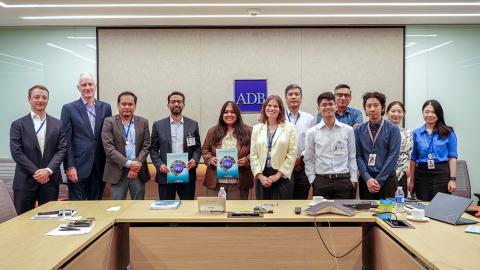
Regional knowledge-sharing session explores stronger transport targets, evidence-based policy, investment pathways, and new analytical tools for climate action
Manila, September 2, 2026: The Energy and Resources Institute (TERI) and the Asian Development Bank (ADB) convened a knowledge-sharing session, “Ramping up the Ambition of Transport-Related Climate Policy Targets in Asia and the Pacific,” to examine how countries across the region can strengthen transport-related climate commitments and translate them into effective policies, investment priorities, and implementation pathways.
The session was held on September 2, 2026 (11:30 AM–12:45 PM IST [2:00–3:15 PM GMT+8]) at ADB Headquarters in Manila and online.
Held in a hybrid format, the session brought together experts and practitioners to discuss the evolving role of transport in national climate action, regional trends in low-carbon transport, and approaches to aligning transport policies with national climate targets. Discussions also explored how stronger evidence, analytical tools, and regional collaboration can help bridge gaps between climate commitments and implementation, while supporting more ambitious and actionable transport-sector climate policies.
A key highlight of the session was the launch of TERI’s new report, Delivering India’s NDC Targets: Role of Transport. The report examines the role of transport in national climate action and assesses how the sector can be better integrated into India’s climate policy and reporting architecture.
The study provides a comprehensive assessment of transport in NDCs, drawing on evidence from India and other countries. It reviews the extent to which transport-specific quantitative targets are incorporated into NDCs globally and assesses patterns across income groups, geographies, transport modes and target types.
The report examines the coverage of transport across national climate submissions, including National Communications, Biennial Update Reports, NDCs and the Long-Term Low Emissions Development Strategy. It also considers the role of transport within India’s national and sub-national climate architecture, including the National Action Plan on Climate Change (NAPCC) and State Action Plans on Climate Change (SAPCCs).
Further, the report identifies opportunities to strengthen transport-sector action through improved data collection and reporting, institutional coordination and monitoring of mitigation outcomes. It also examines pathways for transport decarbonisation across vehicle electrification, fuel efficiency, alternative fuels, public transport and modal shift, with particular attention to high-emission and high-growth segments.
Sharif Qamar, Senior Fellow and Associate Director, TERI highlighted the need for countries –developed as well as developing countries – to adopt data-based approaches to monitor, report and verify emission reduction commitments specific to the transport sector. For instance, Clean Freight Program in India, in line with America’s SmartWay or Europe’s Lean and Green programs, aims to monitor emissions and its reduction from the freight sector, is an ideal mechanism that could be built in the country’s commitment towards climate action. Shreya Gupta, Research Associate, TERI highlighted that transport needs to be treated as a strategic pillar of India’s climate action. TERI’s analysis shows that while India’s economy-wide emission intensity declined by 24% between 2010 and 2020, transport-sector emission intensity increased by 26% during the same period.
The session also provided a platform for discussing how lessons from India and other countries can inform transport-related climate action across Asia and the Pacific. The discussion considered regional trends in low-carbon transport and examined how transport policies across Southeast Asia and the wider Asia-Pacific region align with national climate targets.
James Leather, Director, Transport Sector Office, Asian Development Bank (ADB) emphasised that transport is a major and growing source of greenhouse gas (GHG) emissions in Asia and the Pacific, making progress in the sector critical to achieving countries’ national climate commitments. He highlighted that while significant action is already underway across the region, greater efforts are needed to translate climate targets into practical implementation plans that can guide financing and investment decisions. He further underscored the importance of stronger evidence and analysis in turning climate ambition into effective action.
The session also introduced new tools from the Asian Transport Observatory (ATO) designed to strengthen the evidence base for transport and climate policy across Asia and the Pacific.
The tools cover development assistance flows, electric mobility supply chains and multi-hazard climate risk, including applications across Southeast Asia. These resources can help policymakers and practitioners better understand the financial, technological, developmental, and climate-risk dimensions shaping the transition towards more sustainable and resilient transport systems.
Alvia Mejia, Co-Team Lead, ATO, showcased comprehensive datasets that offer valuable insights into the evolving transport pathways of the Asia-Pacific region under different emissions trajectories. With applications across more than 90 projects since 2000, these datasets have played a significant role in informing regional assessments and reports, particularly across low- and middle-income countries.
The session reinforced the transport sector’s critical role in accelerating climate action, while highlighting the persistent gap between ambition and implementation. Speakers emphasized that this gap can be narrowed through stronger, evidence-based implementation strategies. In India, where transport emissions are increasingly concentrated in medium- and heavy-goods vehicles (MHGVs), the transition will require a focused push towards modal shifts to rail, accelerated vehicle electrification, and strengthened local manufacturing capabilities.
Johanna Zilliacus, Moderator, ADB, brought the session to a close by highlighting the need to build robust evidence to translate policy ambitions into effective implementation. To advance transition in transport, creating measurable evidence is a key to tracking progress, developing projects, and designing diverse, context-specific strategies.
The report Delivering India’s NDC Targets: Role of Transport is available at https://teriin.org/project/delivering-indias-ndc-targets-role-transport.