
Headquarters
The Energy and Resources Institute (TERI)
Darbari Seth Block, Core 6C,
India Habitat Centre, Lodhi Road,
New Delhi - 110 003, India
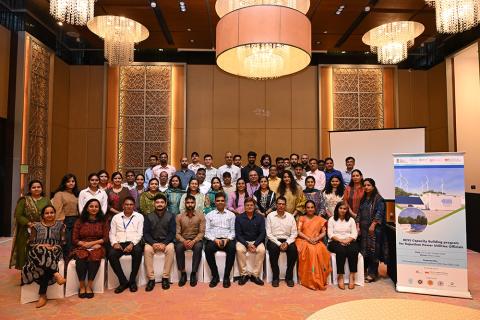
Two-day capacity-building programme in Jaipur focused on battery energy storage technologies, project development, operations and safety
Jaipur, 28 October 2026: The Energy and Resources Institute (TERI), under the Indo-German development cooperation project Energy Storage for Renewable Energy Integration in India (StoREin), conducted a two-day capacity-building programme for officials from Rajasthan’s power utilities on Battery Energy Storage Systems (BESS) on 27–28 October 2026 in Jaipur.
The programme aimed to strengthen the technical and operational understanding of utility officials and support the effective deployment and utilisation of battery energy storage as Rajasthan continues to expand its renewable energy capacity.It brought together 50+ officials from Jodhpur Vidyut Vitran Nigam Limited (JDVVNL), Ajmer Vidyut Vitran Nigam Limited (AVVNL), Jaipur Vidyut Vitran Nigam Limited (JVVNL), Rajasthan Rajya Vidyut Utpadan Nigam Limited (RRVUNL), and CESC Rajasthan, alongside 40+ online participants.
With India targeting net-zero emissions by 2070 and renewable energy capacity continuing to grow, energy storage is emerging as a critical component of a reliable and flexible electricity system. Battery Energy Storage Systems can help manage the variability of solar and wind power, improve grid stability, support peak demand management, and optimise power procurement and the utilisation of existing electricity infrastructure. Rajasthan, which has a significant share of India’s installed solar capacity, has been advancing its energy storage ambitions through policy incentives and large-scale procurement initiatives. Strengthening the capabilities of power utility officials is therefore important to translating these investments into effective implementation and operation.
Mr. Sunil Sharma, Director-NRE & RCM from the Ministry of Power, highlighted the growing importance of Battery Energy Storage Systems (BESS) in supporting India’s renewable energy expansion. Referring to national planning estimates, he noted that India’s BESS requirement is projected to reach 236 GWh by 2031–32. He also highlighted Government of India’s initiatives, including Viability Gap Funding (VGF), to support the development of the BESS projects. He encouraged participating utility officials to leverage the programme to understand suitable BESS applications, project economics and the integration of storage into utility operations and power system planning.
Emphasising the relevance of the programme for Rajasthan’s power sector, Mr. S. K. Rajput, Additional Chief Engineer, Jaipur Vidyut Vitran Nigam Limited (JVVNL), emphasised the importance of Battery Energy Storage Systems (BESS) in managing peak demand, reducing power procurement costs and improving renewable energy integration in Rajasthan. He highlighted the need for utility officials to understand BESS applications, system sizing, operational requirements and project economics to enable effective deployment. He appreciated TERI and GIZ for organising the two-day capacity-building programme under the Indo-German StoREin project, noting its relevance in strengthening the technical capacity of Rajasthan’s power utilities to plan and implement viable energy storage solutions.
The programme brought together technical expertise from TERI, GIZ, IIT Bombay, the India Energy Storage Alliance (IESA), the Global Energy Alliance for People and Planet (GEAPP), PwC, the International Solar Alliance (ISA), BSES Rajdhani Power Limited (BRPL), UL Solutions, and Pace Digitek to provide officials from Rajasthan’s power utilities with a comprehensive understanding of battery energy storage technologies, applications, project development, grid integration, safety, and operations and maintenance.
The sessions covered battery energy storage technologies, battery chemistries and emerging trends; India’s policy and regulatory framework; Rajasthan’s power system and the role of BESS; and key applications and components. Discussions also focused on project development, technical and financial feasibility, business models, implementation, and second-life applications of EV batteries. A case study on Pugal Solar Park highlighted project development, grid connectivity, power evacuation and BESS integration. Further sessions addressed DISCOM digitalisation, power scheduling and ancillary services, battery safety and environmental standards, BESS design, grid connectivity, and operations and maintenance, including performance monitoring, energy management and cybersecurity.
The programme concluded with participant feedback and assessment, followed by closing remarks by Mr. R.K Sharma, Director, Technical, JVVNL and vote of thanks by Mr. Subhankar Mazumdar, Energy Advisor, GIZ and the distribution of certificates.
By bringing together technical knowledge and implementation-oriented insights, the initiative sought to equip Rajasthan’s power utilities with the understanding required to assess, deploy, and operate battery energy storage systems effectively. The programme forms part of the broader effort under StoREin to facilitate the integration of renewable energy into India’s power system through enhanced energy storage capabilities and institutional capacity-building.