Headquarters
The Energy and Resources Institute (TERI)
Darbari Seth Block, Core 6C,
India Habitat Centre, Lodhi Road,
New Delhi - 110 003, India
TERI and the University of Warwick bring together young innovators to explore sustainable waste management, circular economy, and community-led environmental solutions
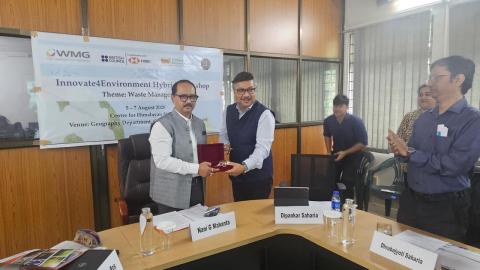
Guwahati | 5 August 2026: The Energy and Resources Institute (TERI), in partnership with the Warwick Manufacturing Group (WMG), University of Warwick, today inaugurated the three-day Innovate4Environment Hybrid Workshop on Waste Management at the Centre for Himalayan Studies, Guwahati. Bringing together young participants from India and the United Kingdom, the workshop aims to equip youth with practical knowledge, technical skills, and an innovation-driven mindset to develop sustainable solutions for waste management and resource efficiency.
Supported under the British Council’s Climate Skills Global Collaboration Grants, Innovate4Environment is designed to strengthen climate-relevant skills through interdisciplinary learning, mentorship, international collaboration, and hands-on project development. The workshop forms part of a broader UK–India partnership that seeks to nurture young climate leaders capable of translating innovative ideas into impactful community action.
Welcoming participants, Dr Livleen K. Kahlon, Director, Environment Education and Awareness (EEA), TERI, underscored the importance of empowering young people with the knowledge and skills needed to address environmental challenges through innovation and collaboration. Dr Kahlon said, “Young people have the potential to drive transformative climate action by integrating technical, social, economic, and environmental perspectives. Innovate4Environment brings together youth from India and the UK to exchange ideas, learn from cross-country experiences, and develop practical solutions for a more sustainable future.”
Delivering the keynote address, Dr Dipankar Saharia, Senior Director, Social Transformation & Strategic Alliance Programme, TERI, highlighted the growing importance of sustainable waste management in advancing climate resilience and circular economy practices. “Scientific knowledge achieves its true value only when it is translated into practical solutions that improve lives. By equipping young people with climate skills and environmental awareness, we are preparing a generation capable of leading the transition towards a more sustainable future,” said Dr Saharia.
Addressing the gathering, Dr Nani Gopal Mahanta, Vice-Chancellor, Gauhati University emphasized the need for integrated and sustainable approaches to urban waste management to safeguard Assam’s ecological future. Dr Mahanta averred, “Waste management is not just a challenge–it is one of Assam’s most pressing priorities. As our cities continue to grow, sustainable waste management, resource recovery, and responsible consumption must become central to our development agenda.”
The inaugural day also featured a panel discussion on ‘Case Studies on Effective Waste Management’, bringing together experts from government, academia, and research to share practical insights on sustainable waste management, circular economy approaches, and collaborative action for cleaner cities and communities. Professor Partha Pratim Baruah, Head, Department of Environmental Science, Gauhati University, emphasized the role of scientific research, environmental education, and youth-led innovation in advancing sustainable waste management and circular economy practices. Prof. Baruah shared, “Sustainable waste management begins with behavioural change. Lasting environmental impact can only be achieved when responsible waste management practices become an integral part of our everyday lives. Policies and regulations alone cannot address the waste management challenge. Their effectiveness depends on consistent implementation, public participation, and shared accountability.”
The opening day introduced participants to the Innovate4Environment programme and aligned the workshop theme with their Social Action Projects (SAPs). Technical sessions focused on waste remediation and ecosystem restoration, project management, effective communication, waste-to-energy technologies, circular economy approaches, and Mission LiFE as a pathway to sustainable livelihoods. A panel discussion featuring experts from TERI, Gauhati University, and the Guwahati Municipal Corporation provided participants with practical insights into effective waste management practices, policy implementation, and emerging opportunities in the sector.
Over the next two days, participants will move beyond the classroom through immersive field-based learning. On Day 2, they will visit Lok Bhawan Assam to observe a Zero-Waste Campus model, followed by visits to a Material Recovery Facility and a legacy waste treatment site, where they will examine waste segregation, resource recovery, remediation practices, and on-ground implementation of sustainable waste management systems. Guided discussions with experts will enable participants to reflect on key observations, identify operational challenges, and document best practices that can inform their own project ideas.
The workshop will conclude on Day 3 with collaborative learning and presentations of participants' Social Action Projects. Following a recap of the workshop and field visits, participants will undertake a hands-on marketplace waste assessment before presenting their project proposals to mentors and experts. The final day will also include detailed feedback sessions and a valedictory programme, recognizing participants’ efforts and encouraging them to translate their ideas into practical, community-driven climate solutions.
Innovate4Environment builds on the success of the Climate Skills – Seeds for a Transition initiative and will engage 130 young participants (100 from India and 30 from the UK) through interdisciplinary learning, technical mentorship, prototype development, and cross-cultural collaboration. The programme equips young people with climate-relevant technical skills, entrepreneurial capabilities, and practical experience to develop innovative solutions addressing environmental and sustainability challenges.