Headquarters
The Energy and Resources Institute (TERI)
Darbari Seth Block, Core 6C,
India Habitat Centre, Lodhi Road,
New Delhi - 110 003, India
World Symposium brought together international scholars, philosophers and institutional leaders to examine the intersections of civilizational wisdom, ethics, governance, artificial intelligence and ecological sustainability
Varanasi, 3 November 2026: The Energy and Resources Institute (TERI), alongside international institutional partners, was part of the World Symposium, Ancient Wisdom for Modern Challenges, held from 2–4 November 2026 at Taj Ganges, Varanasi. Bringing together eminent scholars, philosophers, academics and thought leaders from across the world, the symposium facilitated an interdisciplinary dialogue on how ancient philosophical and wisdom traditions can inform contemporary approaches to global challenges, including geopolitical tensions, ethical governance, technological transformation, ecological sustainability and human flourishing.
Part of the ongoing Aristotle–Confucius Symposium initiative, the Varanasi convening sought to deepen engagement across diverse civilizational traditions, including Aristotelian, Confucian, Hindu, Buddhist, Jain, Islamic and Catholic traditions. The discussions were anchored in the recognition that addressing the complex challenges of the contemporary world requires not only technological and institutional solutions but also deeper ethical foundations, mutual understanding, and international cooperation.
The symposium opened on 2 November with welcome remarks by Dr Nirupam Bajpai, Director, South Asia Program, Columbia University, followed by a keynote address by Dr Priti Adani, Chairperson, Adani Foundation, and the foundational address by Prof. Jeffrey D. Sachs, University Professor, Columbia University, and President, UN Sustainable Development Solutions Network (UN SDSN).
Dr Nirupam Bajpai said that the participants of the symposium would, among other things, discuss modern days challenges of wars, the climate crisis, and the implications of AI on jobs and explore how ancient knowledge and wisdom can help address any of these crises. He said that since the focus of this symposium was on Hinduism, Buddhism, and Jainism, Varanasi was the most appropriate place in India to host this symposium in.
Mr Vivek Aggarwal, Secretary, Ministry of Culture, Government of India, said, “Artificial intelligence can help decipher ancient scriptures, deepen our understanding of their wisdom and make India’s civilizational knowledge more accessible and relevant to future generations.”
Dr Priti Adani, Chairperson, Adani Foundation, highlighted, “Ancient wisdom does not become valuable simply because it is ancient. It becomes valuable when we discover its relevance to contemporary problems. Knowledge gives us the power to change the world. Wisdom assures us that we change it for the better.”
In his address, ‘The Return of a Multipolar World,’ Professor Jeffrey D. Sachs, President of the UN Sustainable Development Solutions Network and Director of the Center for Sustainable Development at Columbia University, examined the shifting balance of global economic power and India's growing role in it. He traced India's share of global output from 5.2% in 2000 to 8.5% in 2026, projecting it to reach 13.1% by 2050 and 15.1% by 2100. He also outlined the changing economic balance towards Asia and Africa, with the combined share of the United States, Canada and Europe projected to decline to 13.7% by 2100.
The symposium featured a series of thematic discussions exploring the relevance of philosophical traditions to contemporary questions of peace, human flourishing, governance, technological advancement and ecological sustainability.
The opening day’s sessions examined cross-civilizational dialogue and peace, the architecture of the good life and human flourishing, and comparative perspectives on Greek and Chinese philosophical traditions. Speakers included Siseko Kumalo, Thaddeus Metz, Gauri Mahulikar, Zahraa McDonald, Chiara Robbiano, Balaganapathi Devarakonda, Owen Flanagan, George Bebedelis, Yong Li, Workineh Kelbessa Golga, Khieng Sothy, Bryan Van Norden, Fang Zhaohui, Matthew Walker, Maria Protopapas-Marneli, and Stelios Virvidakis.
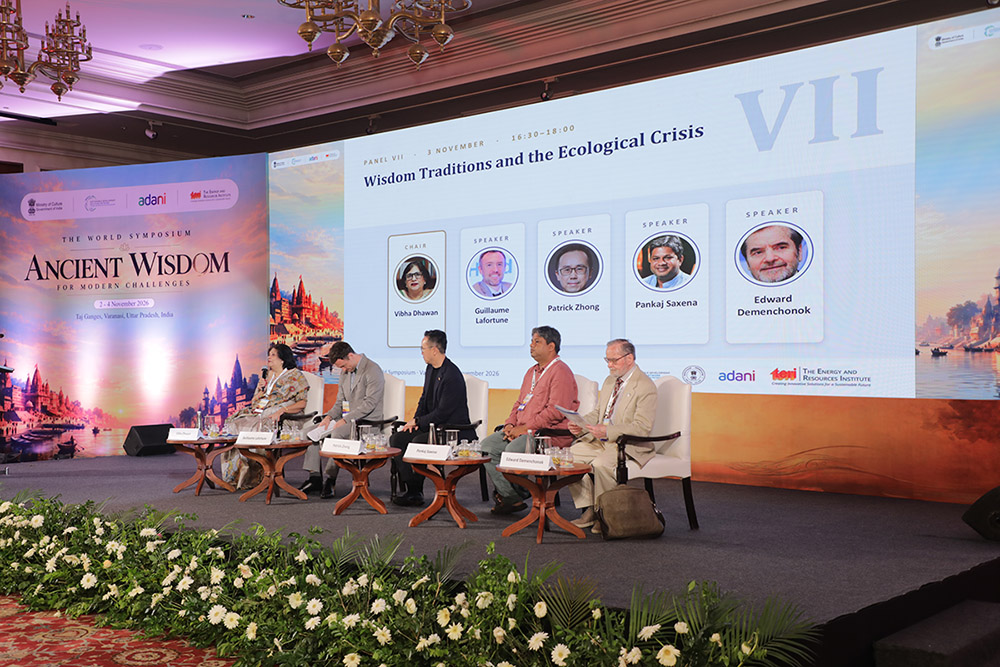
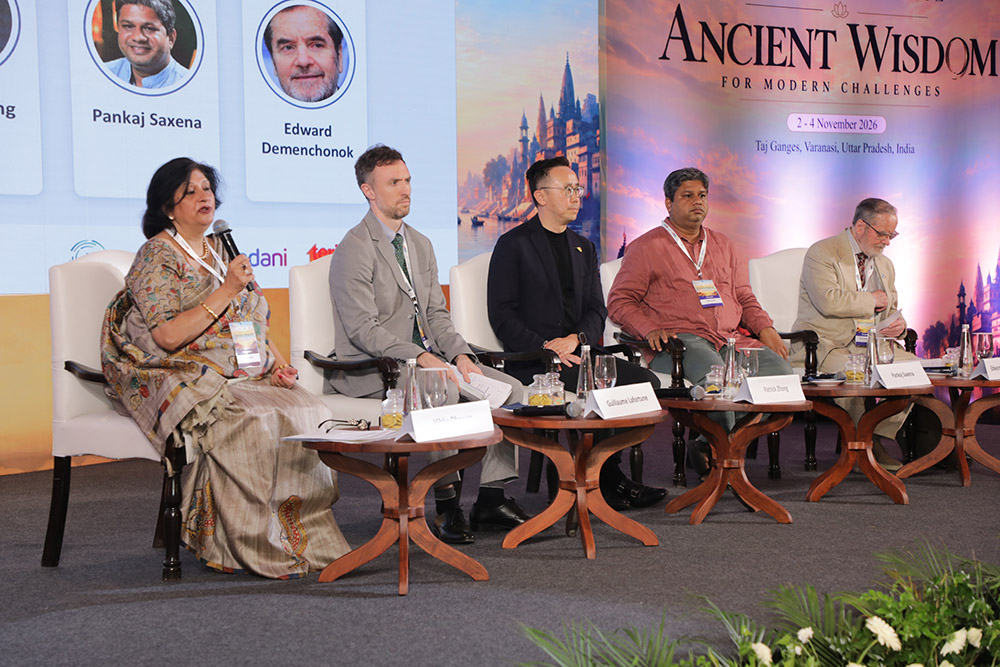
The second day focused on ethical leadership, governance and the common good; artificial intelligence and wisdom traditions; political thought and ethics of power; and the relationship between wisdom traditions and the ecological crisis. The discussions featured Manjeet Ramgotra, Justin Tiwald, Marcelo Sánchez Sorondo, Kou Sopheap, Agnieszka Karolina Rostalska, Riccardo Pozzo, Yannis Ioannidis, Jan Westerhoff, Niu Xiping, Ajit Chaturvedi, Dilip Menon, Douglas Berger, Zinhle KaNobuhlaluse, Krishna Mani Pathak, Ami Ganatra, Dr Vibha Dhawan, Guillaume Lafortune, Patrick Zhong, Pankaj Saxena, and Edward Demenchonok.
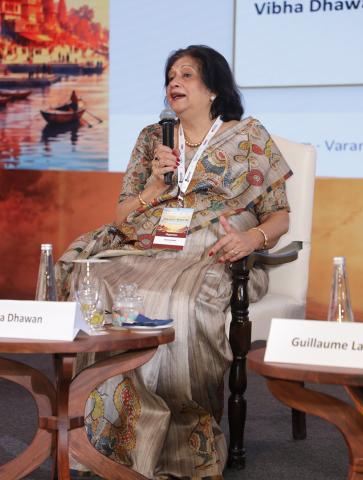
On the relevance of wisdom traditions to ecological sustainability, climate action, and contemporary global challenges, Dr Vibha Dhawan, Director General, TERI, said, “We are talking about a session on wisdom traditions and the ecological crisis. I really don’t need to elaborate on the ecological crisis because newspapers report some calamity or another every day. This is largely because we have damaged our fragile ecosystems, and some may have reached a point of no return. Many others, however, have reached a stage where we are not even sure what needs to be done. We are talking about the melting of glaciers. I would say that about 20 years ago, when TERI spoke about this issue, it was taken rather lightly, with people questioning the science behind it.”
A key focus of the Varanasi symposium was the integration of Indian philosophical and spiritual traditions into a wider global conversation. Varanasi, also known as Kashi, offers a distinctive setting for this engagement, given its historical and spiritual significance across Hinduism, Buddhism and Jainism. The symposium also built on an expanding network of international institutional collaborations, including engagement with Greek institutions, the Nishan Forum on World Civilizations, the Confucius Institute and the Pontifical Academy of Social Sciences.
As part of the programme, 4 November 2026 was dedicated to cultural immersion in Varanasi. Participants undertook a guided walk along the ghats, beginning at Dashashwamedh Ghat, followed by a visit to the Kashi Vishwanath Temple and corridor.
The symposium aimed to advance a more inclusive approach to global dialogue by bringing diverse philosophical traditions into conversation with contemporary challenges and strengthening the ethical foundations of international cooperation.