
Coastal communities face increasing socio-economic vulnerability due to fluctuating marine catches and changing monsoonal patterns.
Why mangrove fruits matter
Mangrove research has generally centered on biogeochemical cycling, carbon storage, shoreline protection and fisheries support. In contrast, mangrove fruits have received far less attention despite their abundance and importance as edible food source. Coastal communities face increasing socio-economic vulnerability due to fluctuating marine catches and changing monsoonal patterns. They are continuously in search of alternative livelihood options aside from fishery and agriculture. Efforts to process mangrove fruit can create jobs and overcome poverty in coastal areas.
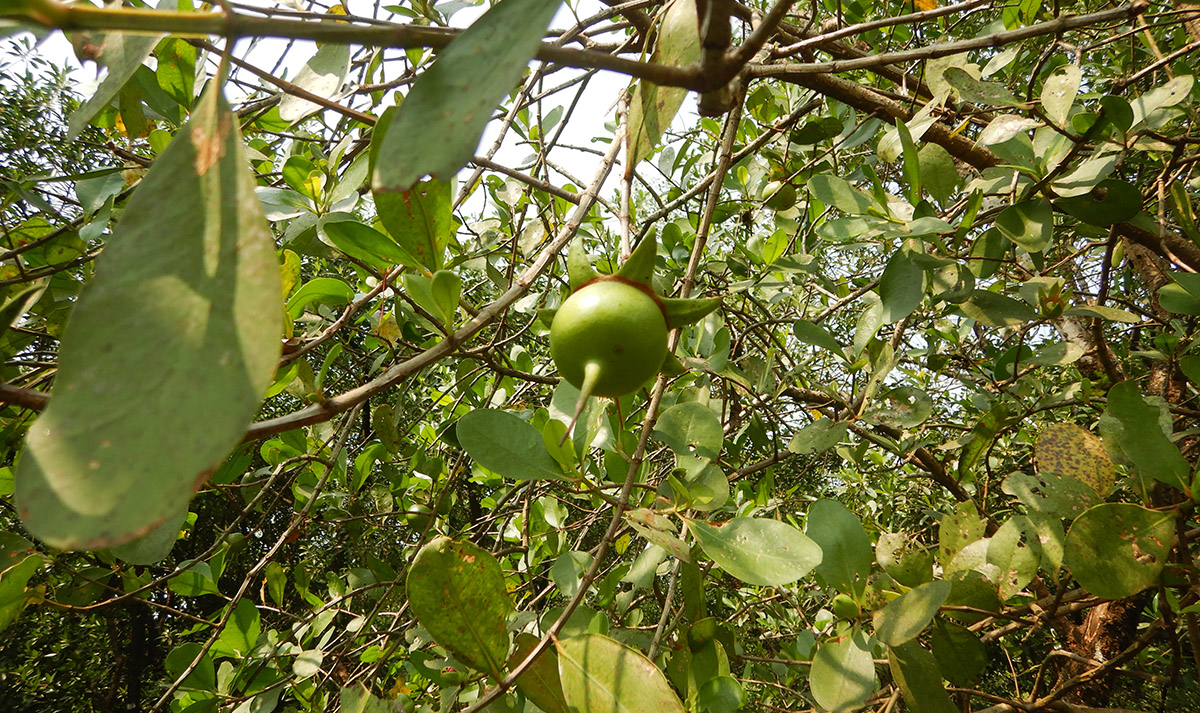
Each season, fruits of Sonneratia caseolaris (known as ‘mangrove apple’ Fig. 1), S. alba, Kandelia candel and Rhizophora mucronata fall onto the tidal mudflats of estuaries and decompose. As far as current evidence shows, none of this biomass enters into a food or product chain. The mangrove fruits exhibit an excellent prospect of transforming into high economic food products. While recent research on various mangrove species (majorly 16) identified several culinary and therapeutic usages of fruits, these works (and commercial products) remain mostly limited to China and Indonesia (Midhuna et al., 2026). Published work on edible mangrove fruits is concentrated in Indonesia and China.
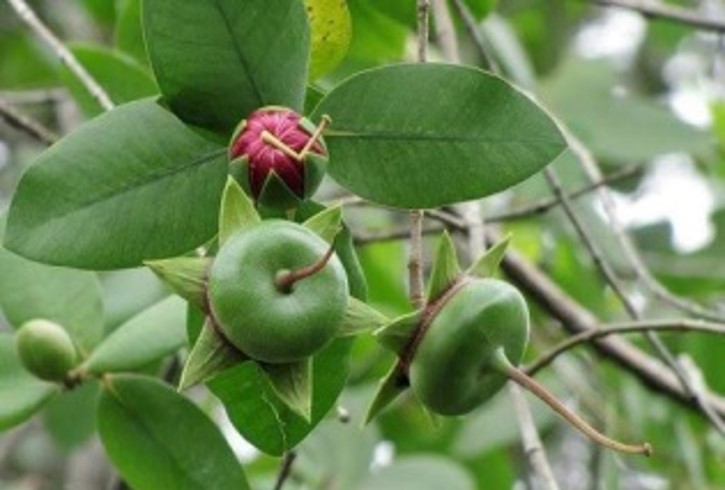
Fig. 1: Sonneratia caseolaris or mangrove apple (Goa, October 2025)
In India, their use remains local, such as the pickling and souring use of S. apetala (keora) fruit in the Sundarbans. A 2015 Sundarbans study by Ray and co-workers reported nutritional composition and antioxidant properties of few wild mangrove fruits that were comparable with popular commercial fruits. Presence of commonly occurring antioxidants and flavanols like catechin has been detected in Heriteira fomes and Bruguiera parviflora of the Sundarbans (Fig. 2).
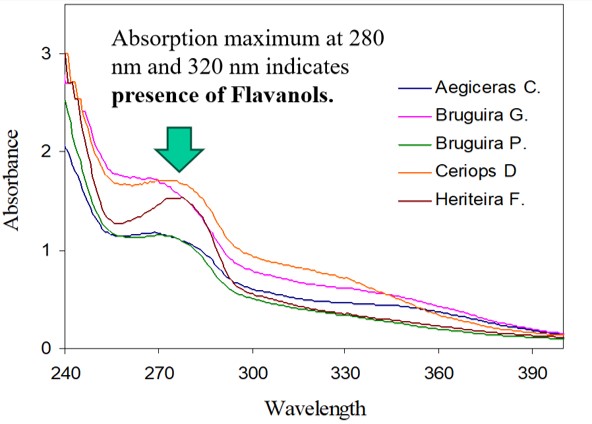
Fig. 2:UV-Visible spectral scan of five mangrove species (referred by Ray et al., 2015)
Although the study in Sundarbans is a useful reference point, but it covers a different estuarine system and species mix, and it did not test processed products and did not consider seasonality and salinity influence on fruit maturation.
A recent survey by TERI in North Goa indicate that fruit availability is structured by salinity and season. Mature S. caseolaris and K. candel were associated with low-salinity, Avicennia marina and R. mucronata with intermediate, and S. alba and A. officinalis with high-salinity estuaries and rivers. Now the questions are:
Does the salinity gradient shape fruit chemistry as well as availability? Salinity influences osmolyte production, phenolic content and nutrient allocation in mangroves. If fruits of one species differ in composition between low- and high-salinity sites, the estuarine gradient becomes both a sourcing variable and a research question.
How safe are the fruits, and for which species? Tannins and cyanogenic compounds are known concerns in some species. Cyanide, phenolics and trace elements must be measured before any food use is considered, and detoxification options (pulping, drying etc.) tested against measured outcomes. Species with unfavorable profiles should be dropped. This screening is the main scientific filter in the pathway.
Which processing routes preserve useful compounds? Pasteurisation, drying and milling can degrade antioxidants, so the trade-off between safety and retained bioactivity should be quantified, not assumed.
A bioeconomic model should be established (Fig. 3) as an integrated value chain flowing from upstream community-led wild harvesting of mangrove fruits, through midstream laboratory detoxification and safety validation to downstream processing and commercial distribution via local Self-help groups (SHGs) under a local brand at the onset.
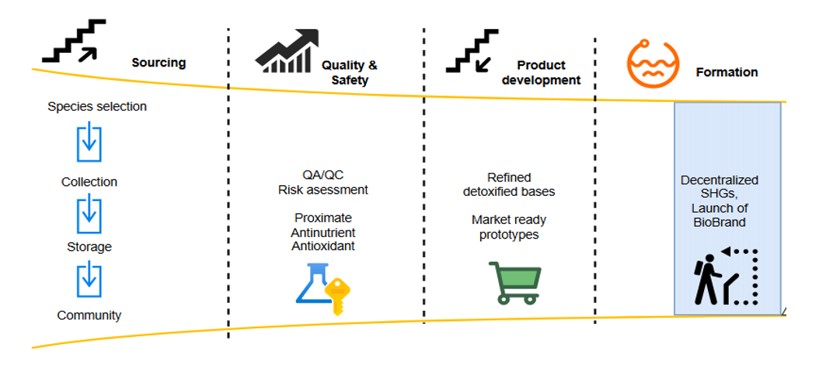
Fig. 3: An integrated bioeconomic model from raw fruit to bioproducts
As an initial pilot or phase 1, primary focus should be on establishing a sustainable raw material pipeline through targeted mangrove species selection, community-led wild harvesting, and standardized storage protocols, running concurrently with a rigorous quality and safety framework. This initial phase utilizes laboratory-backed QA/QC and risk assessments to analyze proximate parameters, verify antioxidant capacities, and safely neutralize naturally occurring anti-nutrients. Analytical work at a Food Safety and Standard accredited laboratory would give a defensible basis for later product work. As per the most conservative estimate, 6 to 8 ton of harvested and processed Sonneratia alba per hectare should be available for product development.
After the success in phase 1, a shift would take towards phase 2 through downstream commercialization by transforming these refined, detoxified bases into shelf-stable, market-ready prototypes like ready-to-drink beverages and functional flours. The operational scaling relies on a decentralized formation model that transfers these production technologies to local women's SHGs for the official commercial bioproduct. Whether it yields meaningful income, and whether that income strengthens community interest in mangrove protection and restoration, are hypotheses needing household-level evidence.
References
Midhuna, K., Raman, M. & Surendran, A. 2026. Nutritional and bioactive diversity of mangrove fruits: a comparative perspective for functional food development. Food Sci Biotechnol 35, 3501–3520.
R. Ray, A. Banerjee, J. Mullick and T. K. Jana. 2015. Nutritional composition of some selected wild mangrove fruits of Sundarbans. Indian Journal of Geo-Marine Science. 44(7), 1059- 1066