
Headquarters
The Energy and Resources Institute (TERI)
Darbari Seth Block, Core 6C,
India Habitat Centre, Lodhi Road,
New Delhi - 110 003, India
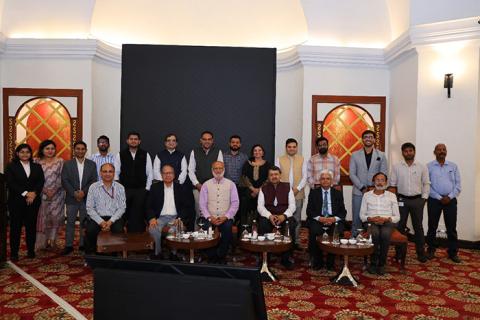
Experts from CEA, DISCOMS, and leading industry bodies deliberate on procurement reforms, grid flexibility, Storage technology readiness
New Delhi, 8 November 2025: The Energy and Resources Institute (TERI) hosted a high-level conference on “Accelerating Renewable Energy and Storage Procurement for a Smoother Energy Transition” at The Dome, Hotel Ambassador, New Delhi, on 7 November 2025. The event convened key policymakers, utilities, developers, and technical experts to deliberate on innovative approaches to accelerate India’s renewable energy (RE) and storage integration journey.
Organized against the backdrop of India’s ambitious renewable energy and net-zero targets, the conference aimed to address emerging challenges and opportunities in RE and energy storage procurement and transmission planning. Discussions focused on enabling regulations, financing mechanisms, and market design innovations to build a flexible and resilient power system capable of supporting India’s rapid energy transition.
The session began with a welcome address by Mr AK Saxena, Senior Director, TERI, who outlined the event’s focus on renewable energy procurement, transmission challenges, pumped storage projects, concentrated solar power (CSP), and battery storage for grid stability.
Delivering the keynote address, Mr Ghanshyam Prasad, Chairperson, Central Electricity Authority (CEA), Government of India, emphasized the need to balance renewable and thermal generation to ensure grid reliability. Citing Rajasthan’s recent grid challenges, he noted that surplus renewable generation can create imbalances and underscored the importance of viable storage solutions such as battery and pumped storage systems (PSP), the latter offering the added advantage of inertia.
Mr Prasad also called for localized weather forecasting near generation sites for improved demand estimation, while cautioning against overbuilding transmission capacity. He stressed the importance of developing state-level resource adequacy plans and exploring CSP as an effective storage option in India’s energy transition strategy.
Mr Manu Shrivastava, Additional Chief Secretary, New & Renewable Energy Department, Government of Madhya Pradesh, shared state-level perspectives on renewable energy and storage procurement. He highlighted that Madhya Pradesh currently has 15.4 GW of operational capacity and 40 GW under construction, including new hybrid projects combining solar and storage — such as 2,000 MW of solar with 1,000 MW of battery storage and 1,200 MW solar with long-duration storage. Mr Shrivastava also discussed measures to ensure 95% peak-hour availability, performance-linked penalties, and innovative models such as storage-as-a-service and solar-plus-storage collaborations with Uttar Pradesh. He emphasized the need for adaptable frameworks and inter-state cooperation to enhance grid stability and renewable integration.
The inaugural session was followed by thematic discussions on key focus areas:
Dr Satya Priya Rath, Managing Director, Grid Corporation of Odisha Limited (GRIDCO) highlighted Odisha’s identification of 10–11 new sites for closed-loop PSP feasibility studies. He underlined PSP’s advantages—long life (70–80 years), inertia support, and lower dependency on imports compared to batteries. He noted evacuation challenges and informed about a national PSP portal open till 16 November. Dr Rath also mentioned that the new government policy promotes private participation and exempts concurrence for off-river projects.
Mr Ajay Shankar, Distinguished Fellow, TERI, in his concluding remarks, outlined the way forward for integrating renewable energy with storage solutions such as CSP, PSP, and BESS. He emphasized efficient management of surplus RE and noted that each technology offers distinct advantages—BESS being cost-effective but import-dependent, PSP providing inertia and long life, and CSP enabling applications like hydrogen production, process heat, and agricultural drying.
He stressed the need to scale up CSP in India through targeted policies, while also underlining the importance of capacity-building and supportive government frameworks to promote PSP and BESS adoption. Drawing lessons from global examples such as China and France, Mr Shankar called for coordinated action to build a resilient and balanced RE-plus-storage ecosystem.
Mr Alekhya Datta, Director, TERI extended the Vote of Thanks and reaffirmed TERI’s commitment to supporting the government and industry in advancing the renewable and storage landscape.
The insights and recommendations from the conference will be consolidated into a policy-oriented report, offering practical strategies to strengthen India’s RE and storage ecosystem and accelerate the country’s transition to a sustainable, low-carbon future.