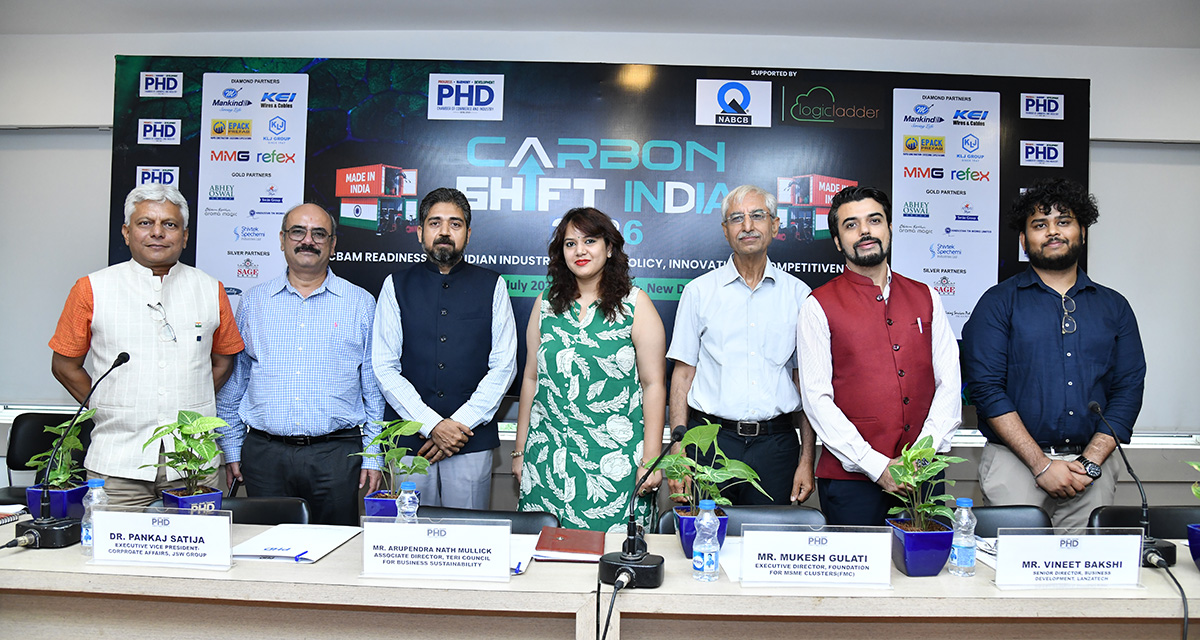
On 03 July 2026, TERI hosted a panel session on “Industrial Decarbonisation, Clean Tech & Green Finance” in New Delhi. Senior leaders from Indian industry emphasized that India's competitiveness will depend on strengthening carbon accounting systems, accelerating industrial decarbonization, supporting MSMEs through technology and finance, and operationalizing the domestic Carbon Credit Trading Scheme. While regulatory negotiations with international partners remain important, speakers consistently stressed that long-term resilience would require coordinated action across government, industry, financial institutions, and technology providers. The panel was moderated by Mr Arupendra Nath Mullick, Associate Director, TERI. The panel was hosted in partnership with the PHD Chambers of Commerce & Industry, under aegis of the CarbonShift India 2026 Summit.
Discussion Summary
Hard-to-Abate Sectors: Technology Scaling & Feedstock Hurdles
- Pankaj Satija (Executive Vice President, JSW Group): Discussed the complex logistical issues of maintaining India's 300-million-tonne steel production goal by 2030 while facing a sharp decline in primary iron ore grades. Domestic ore quality has dropped from 62% iron content in 2011 down to nearly 40% today. This drop forces plants to burn significantly higher volumes of coal per tonne of crude steel produced.
- Technical Interventions: Overcoming this requires upgrading beneficiation infrastructure to remove aluminum content, expanding scrap-metal recycling networks, and scaling green hydrogen injection. JSW is piloting a 20 MW green hydrogen facility at its Vijayanagar plant, which cuts CO2 emissions to 32 kg per tonne of steel. However, scaling this pilot to a commercial 100 MW level involves massive capital expenditures, which increases variable steelmaking costs by several hundred rupees per tonne.
Bio-Recycling and Carbon Utilization Pathways
- Vineet Bakshi (Senior Director, LanzaTech): Presented synthetic biology solutions that transform industrial waste gases into valuable assets. LanzaTech's proprietary gas fermentation technology functions like an industrial bioreactor, consuming carbon-rich steel mill off-gases and converting them into high-purity ethanol in a single step.
- Downstream Commercial Applications: This ethanol serves as a critical low-carbon chemical building block. It is converted into Monoethylene Glycol (MEG) to manufacture polyester yarn for global fashion houses like Zara and Gucci, and serves as a 60-70% formulation base for sustainable perfumes.
- Sustainable Aviation Fuel (SAF): LanzaTech has scaled an Alcohol-to-Jet (ATJ) conversion pathway that yields ASTM D7566 certified sustainable aviation fuel. Capturing and processing just 50 per cent of the current 150 million metric tonnes of Indian steel mill off-gas could produce roughly 7.5 billion liters of low-carbon ethanol, directly strengthening national energy security.
Comprehensive Analysis: The Panipat Textile Cluster Case Study
Mr Mukesh Gulati spoke about a detailed look at the Panipat textile companies highlighting the severe structural vulnerabilities within India's decentralized industrial manufacturing hubs:
- Export Exposure: The cluster generates an annual output of ₹40,000 crore, with 25 per cent of these exports destined for the EU market, placing them squarely in the line of future carbon border measures.
- The Cost of Measurement: Conducting a formal carbon footprint assessment costs between ₹7 lakhs per specific product up to ₹70 lakhs for an entire complex facility, which is a prohibitive cost for small firms.
- Value Chain Fragmentation: Small production units operate blindly, lacking data visibility into where raw materials come from or how waste is aggregated by downstream partners.
- Energy Inefficiencies: The cluster completely lacks electric boiler systems, depending heavily on unmetered biomass and coal combustion.
- The Parity Gap: In comparison, tightly integrated Chinese production clusters achieve structural optimization that delivers finished goods at lower prices per unit compared to fragmented Indian ecosystems.
Green Port Infrastructure & Shipping Corridors
National Maritime Policy Context
- Commodore Debesh Lahiri (Advisor, National Centre of Excellence in Green Ports & Shipping): Outlined the critical role of maritime logistics in national carbon calculations. Sea routes handle 80 per cent of global trade volume; for India, maritime routes carry 95 per cent of trade volume and 68 per cent of total economic value.
The Harit Sagar Green Port Guidelines
The Ministry of Ports, Shipping and Waterways is enforcing the Harit Sagar Green Port Guidelines to align domestic port infrastructure with the Maritime India Vision 2030 and the Maritime Amrit Kaal Vision 2047. These frameworks mandate quantifiable performance indicators tracked via satellite imaging, focusing on:
- Renewable Energy Integration: Sourcing 20 per cent of port energy from renewable platforms by 2030, scaling to 60 per cent by 2040 and 90 per cent by 2047. Ports with land constraints (like Mangalore, which achieved 100 per cent solar self-consumption) will use green Power Purchase Agreements (PPAs) to meet targets.
- Electrification & Green Belts: Phasing out diesel-powered material handling machinery through the Green Truck Transition Program and expanding port green belts to 20 per cent by 2030 and 30 per cent by 2040.
- Shore-to-Ship Power Supply (SSPS): To eliminate emissions from vessels docked at port, the guidelines introduce a clear operational mandate for state-run ports to supply electricity directly from shore facilities.
Bunkering Infrastructure and Green Corridors
To align with the International Maritime Organization's (IMO) net-zero 2050 targets, India is actively developing specialized Green Shipping Corridors. This transformation requires upgrading port side storage, retrofitting pipelines, and training workforce personnel to manage complex alternative fuel combinations
Shipbuilding Capital Upgrades: An estimated demand for ₹10,000 to ₹20,000 crore in specialized infrastructure funding to improve domestic design capabilities and establish a ship recycling credit system (offering 40 per cent of scrap value as a credit note)
