
Headquarters
The Energy and Resources Institute (TERI)
Darbari Seth Block, Core 6C,
India Habitat Centre, Lodhi Road,
New Delhi - 110 003, India
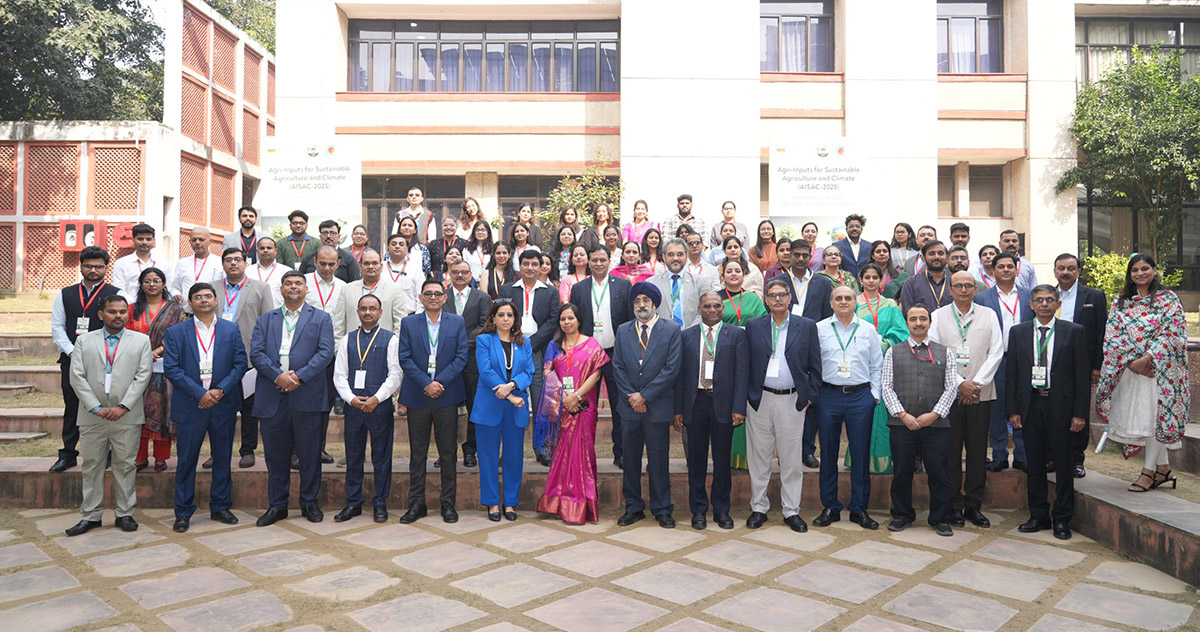
The two-day international conference, ‘Agri-Inputs for Sustainable Agriculture and Climate’ (AISAC-2025), hosted by TERI’s Sustainable Agriculture Division at TERI Gram during November 12 to 13, focused on the research & development, policies & protocols, and brainstormed about strategically important nano (fertilizers and pesticides) and biological (biofertilizers, biostimulants, biopesticides) agri-inputs to enhance agricultural and environmental sustainability. The conference provided a stimulating international platform to deliberate about the delicate rhythm and living connection of Agriculture and Climate.
Day 1 commenced with the Inaugural Session, where Dr Vibha Dhawan (DG, TERI) emphasized the crucial and historical role of agri-inputs in India's agricultural transformation, and Mr Abhay Baijal (MD, CFCL) highlighted the importance of sustainable agriculture as a key driver for food security and climate action. Sardar Manjinder Singh Sirsa, Minister of Industries, Food & Supplies and Environment, Forest & Wildlife (Government of NCT of Delhi) highlighted the importance of such platform: “I firmly believe that through collaborative research, responsible innovation, and shared global commitment, we can build resilient food systems that protect both people and the planet. May AISAC 2025 serve as a beacon of knowledge and inspiration, fostering learning, creativity, and global understanding.” Dr. Suresh Kumar Chaudhari, Director General, The Fertiliser Association of India, in his Inaugural Speech, brought out how enablers of various advanced technologies can help in disseminating knowledge down to the ground level and act as a linkage with various authorities. Mr. H. P. Singh, Former Law Officer, Fertilizer Law Unit, and Consultant, Ministry of Agriculture and Farmers' Welfare highlighted the importance of innovations in the domain of nanobiotechnology and the significance of key dialogues amongst innovators, industries and regulators to make such technologies available at the farm level. It was also a momentous occasion to recall 15 Years of TERI-Deakin Collaboration as reminisced by Ms. Ravneet Pawha, Vice President (Global Engagement) and CEO (South Asia), Deakin University, Office of the Deputy Vice Chancellor, Partnerships. The Inaugural Session ended with Vote of Thanks by Dr. Pushplata Singh (Director, CNR and ABT, TERI).
Day 1 of the conference was on Nano for Agri 2025 where national and international experts deliberated about cutting-edge research on nano-agri-inputs, regulatory perspectives, and policy recommendations for nano agrochemicals. On the other hand, Day 2 of the conference was focussed on biological solutions for sustainable agriculture where experts had stimulating discussions on innovations and challenges in Biofertilizers, Biostimulants, and Biopesticides in India and abroad.
Day 1 consisted of three sessions: (i) Keynote and Invited Talks on ‘New Frontiers of Research on Nano-agrochemicals for Sustainable Agriculture’, (ii) Panel Discussion leading to White Paper - Products and Regulation in advancing nanotechnology for crop nutrition and protection, and (iii) Panel discussion on ‘Integrated progress and dissemination of technologies for sustainable agriculture amongst masses’.
Day 2 of the conference started with an innovative perspective on “Nature Based Solutions for Sustainability in Agriculture” by Dr. Nicolas Tsesmetzis Principal Scientist, NBS, Shell International Exploration and Production Inc. While, Prof. Matthew Clarke, Deakin Distinguished Professor and Deputy Vice- Chancellor, Research and Innovation, Deakin University delivered an inspiring speech
on ‘Sustainability and Environment’ focusing on the economics involved in achieving various intertwined goals.
The technical sessions of Day 2 started with Keynote and Invited talks on ‘Microbial Consortia and Their Role in Soil Health and Plant Growth’ followed by academic sessions on ‘Biostimulants from Natural Sources: Mechanisms and Applications’ and ‘Recent Developments and Future Directions in Biopesticide Technologies’. Two important Panel Discussions were held on this day to discuss about (i) Advancing Biofertilizers and Biostimulants: Insights into Research and Policy, and (ii) Biopesticides – Scope and Challenges. These two panel discussions paved ways for new-age agri-inputs that are still making inroads in the domain of agriculture. Platform Talks and Poster Sessions were also arranged during the conference to encourage young minds.
This unique platform saw participation from various international as well as Indian institutes like ICAR-Indian Agricultural Research Institute, ICAR - Indian Institute of Wheat & Barley Research, National Institute of Technology, Shell India Market Private Limited, and fertilizer industries like Zuari Farm Hub Limited, Coromandel International Limited, Ray Nano Science and Research Centre, Paradeep Phosphates Limited, Indian Farmers Fertiliser Cooperative Limited, Sea6 Energy Private Limited, Sri BioAesthetics Pvt. Limited, Kisan Agrovet, Varsha Bioscience and Technology India Private Limited, regulators from National Test House, National Centre for Organic and Natural Farming, Central Insecticides Board & Registration Committee, and Department of Science and Technology. Senior Researchers from the Sustainable Agriculture Programme, TERI also participated actively in multiple Panel Discussions and delivered Invited Talks.
The conference ended in an energetic note where the participants lauded emphatically about the need to such platform where experts from all walks of life can discuss about synergies with different domains of Sustainable Agriculture.