
Headquarters
The Energy and Resources Institute (TERI)
Darbari Seth Block, Core 6C,
India Habitat Centre, Lodhi Road,
New Delhi - 110 003, India
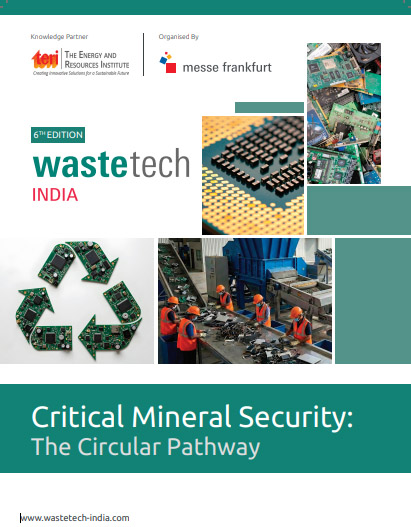
This white paper seeks to reframe electronic waste (e-waste) not merely as an environmental challenge, but as a strategic opportunity for India’s resource and economic future. As the country accelerates its transition toward clean energy systems and digital expansion, the demand for critical minerals—such as lithium, cobalt, nickel, and rare earth elements—is set to rise sharply.
This analysis highlights the untapped potential of e-waste as a secondary resource base capable of contributing significantly to domestic material security. With e-waste volumes projected to grow exponentially in the coming decades, the concept of “urban mining” offers a viable pathway to recover valuable materials, reduce supply chain vulnerabilities, and advance circular economy objectives.
However, the potential of this sector remains constrained by systemic challenges. The dominance of informal processing, gaps in collection and traceability, limited advanced recycling infrastructure, and inefficiencies in Extended Producer Responsibility (EPR) frameworks continue to impede effective resource recovery. These structural bottlenecks not only pose environmental and health risks but also result in significant economic value loss.
To address these gaps, this paper puts forward a set of integrated recommendations aimed at strengthening the ecosystem—ranging from policy and regulatory reforms to technology adoption, market development, and inclusive models for integrating informal actors. Ultimately, circularity must be positioned as a strategic complement to primary resource extraction, enabling India to build a more resilient, self-reliant, and sustainable critical mineral ecosystem.