
Headquarters
The Energy and Resources Institute (TERI)
Darbari Seth Block, Core 6C,
India Habitat Centre, Lodhi Road,
New Delhi - 110 003, India
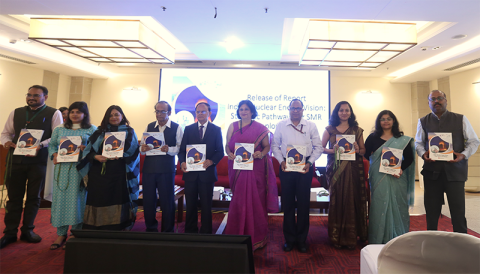
TERI’s report highlights the role of nuclear energy and Small Modular Reactors in strengthening India’s energy security, industrial growth, and low-carbon transition
New Delhi, 12 May 2026: The Energy and Resources Institute (TERI) today released its report titled India’s Nuclear Energy Vision: Strategic Pathways for SMR Deployment at a high-level event held at India Habitat Centre. The programme brought together senior government officials, policymakers, industry leaders, researchers, and international experts to deliberate on the future of nuclear energy and the role of Small Modular Reactors (SMRs) in India’s clean energy transition.
The event emphasized the growing importance of nuclear energy in supporting India’s vision of becoming a developed nation by 2047 through a secure, reliable, and low-carbon energy system. Discussions highlighted the role of nuclear power in ensuring round-the-clock clean energy, strengthening energy security, and supporting industrial growth while advancing decarbonization goals.
The report examined the regulatory, institutional, and market pathways required to support India’s nuclear expansion, with a particular focus on enabling the deployment of Small Modular Reactors. It also highlighted the importance of public engagement, skilled workforce development, adaptive regulatory frameworks, and enhanced private sector participation in building a robust nuclear ecosystem.
The inaugural session commenced with a welcome address by Dr Vibha Dhawan, Director General, TERI. On India’s clean energy transition, Dr Dhawan said, “The vision of Atmanirbhar Bharat must also mean building an energy system that is resilient, secure, and less dependent on external vulnerabilities. Emerging technologies such as Small Modular Reactors open up new possibilities for strengthening energy security, supporting industrial growth, and advancing clean energy goals.” This was followed by context-setting remarks from Mr K Ramanathan, Distinguished Fellow Emeritus, TERI and an overview of the report by Dr Arunendra K Tiwari, Fellow, TERI.The report was officially released in the presence of eminent stakeholders from government, academia, and industry. Delivering a special address, Dr P K Mishra, Principal Secretary to the Prime Minister, PMO, Government of India, highlighted the need for enabling policy and regulatory ecosystems that can support the safe, efficient, and scalable deployment of nuclear technologies in India. Dr Mishra noted, “Clean energy is embedded in India’s development vision not merely as an environmental goal, but as a foundation for growth, competitiveness, social inclusion, and national resilience. Nuclear energy strengthens India’s long-term energy sovereignty, reduces import dependence, enhances strategic autonomy, and provides reliable, clean power at scale.”
Special remarks during the inaugural session were delivered by Mr Ghanshyam Prasad-Central Electricity Authority, Dr Garima Sharma, Head, Safety Security & Safeguards, Department of Atomic Energy and Dr G Vaidyanathan, Retired Scientist and Former Director, Fast Reactor Technology Group, Indira Gandhi Centre for Atomic Research (IGCAR), Department of Atomic Energy. Mr Prasad shared, “As India integrates more renewables into the power system, the biggest challenge will be during non-solar hours. Nuclear can provide firm baseload power in the resource adequacy framework, while SMRs can serve emerging demand centres such as data centres, green hydrogen, and green ammonia.” Dr Sharma added, “The SHANTI Act is not only a legislative reform. It is rewriting a new chapter in nuclear energy in India. It strengthens the regulatory mechanism, enables wider participation, and creates a pathway for PSUs and private industry to contribute to the 100 GW nuclear energy mission.” On Small Modular Reactors and India’s preparedness in technology development and ecosystem creation, Dr Vaidyanathan said, “The idea is not to win a race. The idea is to build safety at every step while accelerating nuclear deployment: regulatory delays must be reduced, public trust must be built nationwide, and the country must train the trainers for the next phase of nuclear growth.”
The second session of the programme featured a high-level panel discussion titled, “Enabling Ecosystems for Small Modular Reactors – Governance, Financing and Implementation Pathways.” The discussion focused on policy frameworks, financing models, regulatory readiness, private sector participation, and implementation pathways associated with SMR deployment in India.
The panel discussion was moderated by Mr K Ramanathan and featured distinguished panelists including Dr Garima Sharma, Mr Prasenjit Pal, Former Executive Director & Head NTPC Parmanu Urja Nigam Ltd., Ms Sama Bilbao y Leon, Director General, World Nuclear Association (joined virtually), Mr Anil V Parab, Director & Sr. Executive Vice President (Heavy Engineering & Manufacturing) L&T and Mr Alok Mishra, Country Director, Westinghouse India (joined virtually).
The event concluded with a vote of thanks delivered by Mr Alekhya Datta, Director TERI.