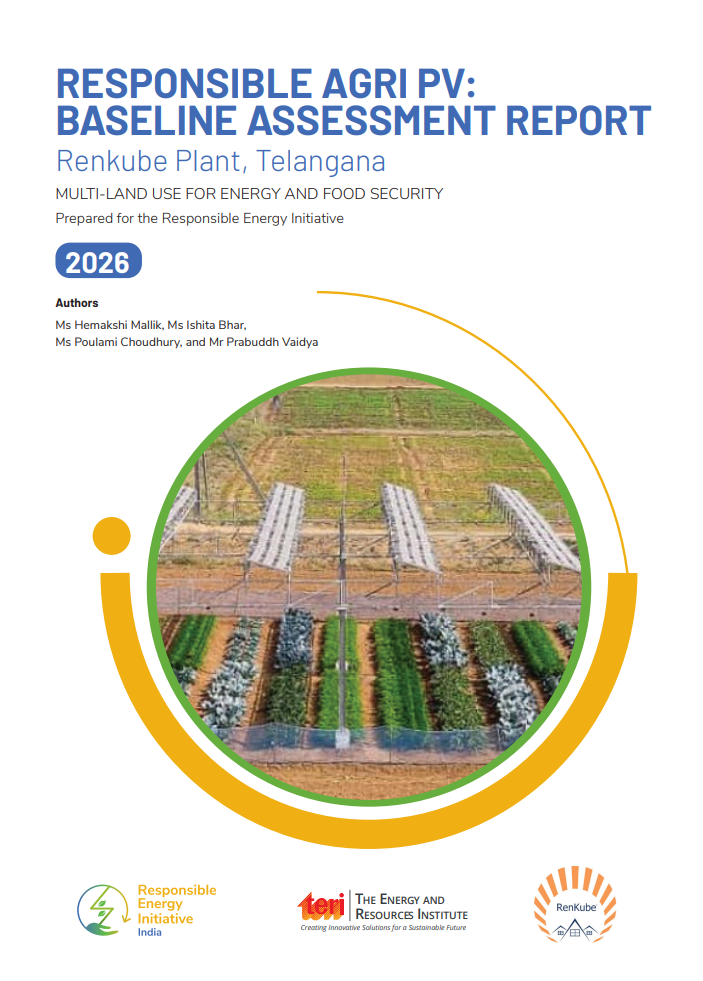
This brief summarizes the findings of the Responsible Agri-PV Baseline Assessment conducted by The Energy and Resources Institute (TERI) under the Responsible Energy Initiative (REI) India. The study examines an institutional agrivoltaics (Agri-PV) pilot implemented by Renkube Pvt. Ltd. in collaboration with Professor Jayashankar Telangana State Agricultural University (PJTSAU).
The primary focus of this assessment is to evaluate the feasibility of co-locating solar power generation with active agriculture in the semi-arid, water-stressed conditions typical of Telangana.
Pilot Overview and Methodology
The pilot features a 10.8 kWp elevated Agri-PV system installed at PJTSAU’s experimental farm in Hyderabad.
- Design: Solar panels are mounted at a height of approximately 3.2 meters, allowing for mechanized and uninterrupted cultivation below.
- Duration: A two-year study period (2022–2024).
- Scope: The site supported the multi-season cultivation of 15 different crops, facilitating a systematic comparison of energy generation, crop productivity, and water use between Agri-PV and traditional open-field conditions.
Key Findings:
The results demonstrate that an "agriculture-first" design can achieve high performance across both energy and food outputs.
- Enhanced Energy Yield: Semi-transparent Agri-PV panels generated a 23% higher specific energy yield than conventional panels, maintaining stable output even during monsoon and diffuse-light conditions.
- Resilient Agriculture: Average crop yields remained robust at 97.8% of open-field levels. Notably, summer leafy vegetables outperformed open-field equivalents due to reduced heat stress.
- Crop Sensitivity: While most crops thrived, some shade-sensitive legumes showed moderate declines, highlighting the necessity of crop-specific deployment strategies.
- Water Conservation: The system reduced reference evapotranspiration by ~16% and achieved up to 25% irrigation water savings, directly addressing Telangana's groundwater stress.
- Land-Use Optimization: The assessment recorded a Land Equivalent Ratio (LER) of 1.78 (rising to 2.34 under enhanced configurations), indicating a significantly higher combined output compared to single-use land systems.
- Financial modeling suggests that integrated Agri-PV systems have the potential to increase farm incomes by 6–8 times. The study identifies developer-owned, lease-based, or partnership models as the most effective pathways to scale, as they limit the initial financial risk to the farmer.
Conclusion and Recommendations
The Renkube-PJTSAU pilot provides compelling evidence that Agri-PV can enhance land productivity and water security while supporting Telangana’s renewable energy transition. However, to transition from pilot to widespread adoption, the following "enablers" are required:
- Policy Support: Differentiated tariffs and streamlined regulatory approvals.
- Financial Incentives: Mechanisms to reduce high upfront capital costs.
- Long-term Data: Continued performance monitoring to build investor and farmer confidence.