
Headquarters
The Energy and Resources Institute (TERI)
Darbari Seth Block, Core 6C,
India Habitat Centre, Lodhi Road,
New Delhi - 110 003, India
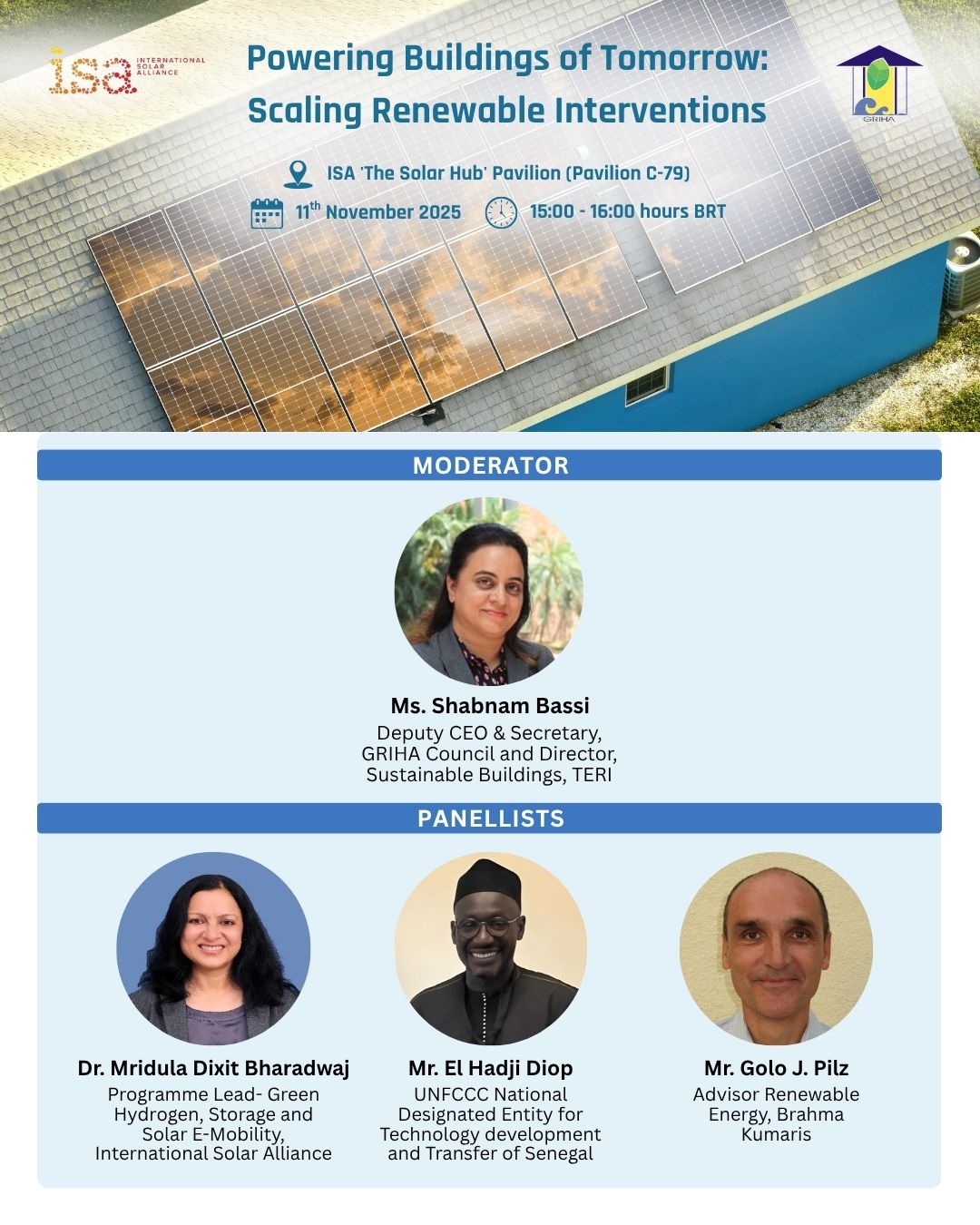
Global energy transition hinges on decisive shift toward renewable sources, with the built environment emerging as a crucial sector to drive transformation. To align with national and international commitments under the Paris Agreement, scaling up solar and renewable adoption within the building sector has become central to achieving net-zero aspirations. Convergence of advanced technologies such as Building-Integrated Photovoltaics (BIPVs), grid-interactive solar systems, and hybrid storage solutions offers promising pathways to make buildings not only energy-efficient but energy-generating ecosystems.
In the Global South, BIPVs offer a high-impact pathway to decarbonize dense cities where rooftop area is constrained by transforming façades and shading mechanisms into power-generating assets. India’s BIPV momentum is reinforced by growing awareness and adoption of green buildings that mainstream solar-integrated designs both for residential and commercial building typologies. While costs, standards, and awareness remain hurdles, targeted measures such as local manufacturing, performance labelling, inclusion in codes and ratings, and grid-interactive operation can enable the market adoption across emerging economies.
?The International Solar Alliance (ISA), a key global platform advancing solar deployment across member nations, plays a catalytic role in enabling policies and collaborations for large-scale adoption. In India, GRIHA Council through GRIHA (Green Rating for Integrated Habitat Assessment), a national green building rating system, has been facilitating the development of sustainable building practices emphasizing sustainable resource management, energy efficiency and renewable integration.
The proposed panel session, “Powering Buildings of Tomorrow: Scaling Renewable Interventions,” curated jointly by ISA and GRIHA Council will bring together global leaders, policymakers, and industry experts to deliberate on strategies driving renewable-ready buildings. This joint session will foster dialogue highlighting cutting-edge innovations, policy enablers, and implementation experiences from diverse geographies, creating a collective vision for renewable-driven urban transformation.
This 60-minute session aims to foster cross-sector learning, identify collaborative mechanisms, and build momentum toward integrating solar and other renewable technologies into built environments globally.
Policymakers and regulators, city administrators, real estate developers, green building professionals, utilities, technology providers, financiers, and development partners.