
Headquarters
The Energy and Resources Institute (TERI)
Darbari Seth Block, Core 6C,
India Habitat Centre, Lodhi Road,
New Delhi - 110 003, India
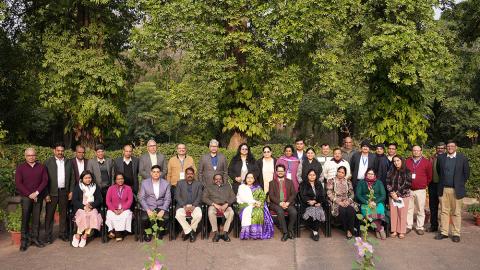
Three-day initiative focused on physical and transition risks, green finance instruments and regulatory preparedness
New Delhi, January 9, 2026: The Energy and Resources Institute (TERI), in collaboration with the Nation Bank Staff College (NBSC), concluded a three-day residential training programme on “Climate Finance Opportunities and Risks”, held from 7–9 January 2026 at the TERI Gram Campus, Gwal Pahari. The participants were senior officials from state offices of the National Bank for Agriculture and Rural Development (NABARD).
Inaugurating the programme, Dr Vibha Dhawan, Director General, TERI, underscoring the critical role of institutions like NABARD said, “Climate change is increasingly reshaping financial systems, development priorities, and risk management frameworks. Adaptation finance is no longer optional—it is essential for safeguarding livelihoods, food security, and rural economies. Capacity building of the financial system is critical to strengthening India’s climate finance ecosystem.”
Speaking at this second of the series of training programmes for NABARD officials, Mr Sanjeev Dalip Singh Rohilla, Chief General Manager, Department of Climate Action & Sustainability, NABARD, said, “For NABARD, climate finance is not a theoretical construct—it will define the future growth of the institution. India requires massive investment to meet its climate commitments, and most of this capital must flow into rural infrastructure. Climate finance has to be approached as a commercially viable, collaborative, and scalable business opportunity.”
Highlighting the evolving policy and regulatory landscape and the importance of sustainable finance frameworks, Ms Shweta Kumar, Director, Ministry of Environment, Forest and Climate Change (MoEFCC) observed, “Climate change has evolved from a specialized environmental concern into a fundamental pillar of global governance, deeply intertwined with economic growth, energy security, and geopolitics. Effective climate policy must be rooted in realism, sequencing, and trust, supported by credible climate finance delivery rather than announcements alone”.
Mr RR Rashmi, Distinguished Fellow, TERI and former Special Secretary, MoEFCC underscored the need for the banking system to better equip itself with the vulnerabilities and risks due to climate change. He noted that while “growth provides the fiscal space and resources needed for climate investment, while climate vulnerability must be systematically built into financing decisions and impact frameworks.”
The programme covered key themes including global and national climate commitments, physical risk assessment, climate finance mechanisms, ESG and climate-related disclosures, transition risks, carbon markets, and green taxonomy. Discussions focused on strengthening institutional capacity to align financial systems with India’s climate goals, highlighting growing climate-induced financial risks across agriculture, MSMEs, and infrastructure, and the need to embed climate risk assessment and green finance into core financial operations. The final day featured sessions on biofuels and green chemicals, emerging regulatory environment for climate finance, a demonstration of TERI’s interactive Climate Tool, and an open discussion on cross-cutting themes.
Participants also undertook field visits to the National Institute of Solar Energy (NISE) and the TERI Gram Campus, providing practical exposure to renewable energy applications and sustainability initiatives.
At the valedictory session, Ms Shefali Agarwal, CGM/Principal, NBSC shared, “Climate finance presents both an opportunity and a responsibility for development finance institutions like NABARD. We need to develop processes for evaluating risks linked to emerging technologies, uncertain revenue models, and changing regulations.”
Delivering her valedictory address, Ms Leena Nandan, Distinguished Fellow, TERI asserted that, “the reach of NABARD to villages and communities enables them to test new solutions and provide critical policy feedback. The partnership between NABARD and TERI in exploring new ideas for sustainable economic returns will play an important role in India’s development.” Dr Sudarshan, NBSC added that TERI and NABARD are building a close cooperation to continue similar capacity building programmes.
Experts included Anand Kumbhare (IIFCL), Gaurav Sharma (NSE), Mrinal Ranjan (NABARD), Suruchi Bhadwal, Manish Srivastava, Prasoon Singh, Sidharth Sinha, Piyal Das, Varun Grover, Amshika Amar, and Vibhu Bhateja from TERI.