
Headquarters
The Energy and Resources Institute (TERI)
Darbari Seth Block, Core 6C,
India Habitat Centre, Lodhi Road,
New Delhi - 110 003, India
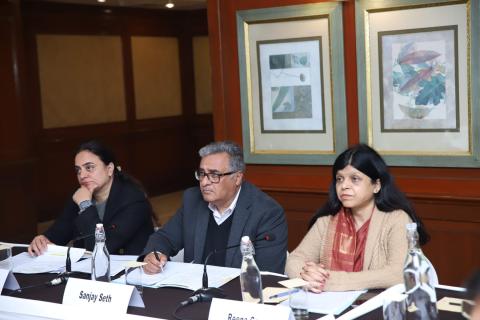
Stakeholder consultation on scaling BIPV integration in India
New Delhi | 21 January 2026: As India advances towards its net-zero target by 2070, the Green Rating for Integrated Habitat Assessment (GRIHA) Council and The Energy and Resources Institute (TERI) organized a Stakeholder Consultation Workshop on “Scaling BIPV Integration in India: Challenges & Opportunities” at the India Habitat Centre, New Delhi.
The consultation brought together policymakers, industry leaders, architects, researchers, financial institutions, and international experts to deliberate on pathways for accelerating the adoption of Building-Integrated Photovoltaics (BIPV) in India’s rapidly growing built environment. BIPV systems integrate solar power generation directly into building elements, such as façades, roofs, glazing and shading devices, enabling buildings to become active producers of clean energy without requiring additional land.
Delivering the welcome address, Mr Sanjay Seth, Vice President & CEO, GRIHA Council, and Senior Director, Sustainable Infrastructure Programme, TERI, underscored the critical role of the building sector in India’s climate transition, and said, “Solar deployment is accelerating at record speed, with ~380 GW installed globally by mid-2025 and ~30 GW added in India between April–December 2025 showing that technology and cost are no longer the main barriers. The real challenge now lies in integration, delivery, and regulation. While BIPV adoption remains small in Europe (~315 MWp in 2023, ~0.5% of total PV), this is not a technology issue but a policy, procurement, and risk-clarity problem. With India’s IESS 2047 projecting buildings to account for ~38% of total electricity demand, the building envelope must be treated as a serious energy surface. BEE’s latest energy scenario reporting shows commercial buildings are a significant and growing demand segment, meaning design-stage decisions matter. India’s building codes ECSBC 2024 and Eco Niwas Samhita already provide a regulatory foundation for BIPV. What is now needed is a clear, predictable approval and procurement framework to make BIPV bankable, approvable, and scalable.”
An online special address was delivered by Scientia Professor Deo Prasad AO FTSE, CEO, NSW Decarbonisation Innovation Hub, University of New South Wales, Australia, highlighting global best practices and innovation trends in BIPV deployment. He noted, “Global examples from Australia and Singapore highlight how strong policy support, falling solar costs, and large-scale demonstrations have accelerated clean energy adoption. Smart incentives, net-zero buildings, and demand-side generation are proving crucial for building resilient, future-ready energy systems.”
A special address by Ms Reena Garg, Deputy Director General (Standardization-I), Bureau of Indian Standards (BIS) emphasized the importance of standards and codes in mainstreaming BIPV solutions in India’s construction ecosystem. “With India’s net-zero target for 2070, rapidly scaling renewable energy and adopting innovative solutions like BIPV where existing building surfaces can be productively utilized is essential. Unlike conventional PV systems, BIPV standardization faces additional challenges related to structural integrity, safety, durability, and the need for a coordinated and harmonized approach across the building and energy sectors. Collaboration among stakeholders is key, while standardization is the enabling process, one that is still evolving and must ensure clear quality benchmarks. In this context, standards play a critical role, and to address these aspects, BIS has constituted the ETD 28 Committee titled, ‘Solar PV Energy Systems,’” noted Ms Garg.
The stakeholder discussion focused on key enablers and barriers to large-scale BIPV adoption, including integration with national building codes and municipal by-laws, alignment with flagship programmes such as PM Surya Ghar Yojana, economic viability and financing frameworks, lifecycle cost-benefit analysis, capacity building, and technical skill development. A technology presentation on façade-integrated BIPV was also delivered by Mr Prateek Jain, Founder & CEO, FutrBuilds.
Participants included representatives from MNRE, BIS, BEE, ISA, NISE, Invest India, World Bank, UNDP, GIZ, CSIR, academic institutions, industry associations, material manufacturers, architects, and clean energy companies, reflecting the multi-stakeholder nature of the emerging BIPV ecosystem.
The deliberations aimed to outline actionable recommendations for embedding BIPV into India’s construction and urban planning framework, strengthening market readiness, advancing material innovation, and addressing end-of-life and e-waste considerations. The outcomes are expected to contribute towards enabling smart, climate-responsive and net-zero buildings across India’s cities.