
Headquarters
The Energy and Resources Institute (TERI)
Darbari Seth Block, Core 6C,
India Habitat Centre, Lodhi Road,
New Delhi - 110 003, India
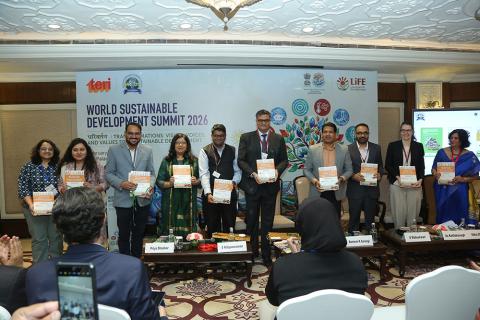
New reports, a DPR framework, and a business model selection tool unveiled during a thematic track at the silver jubilee edition of the World Sustainable Development Summit 2026 to support responsible scale-up of agrivoltaics and strengthen the food–energy–land nexus in India.
New Delhi, 9 March 2026: The Energy and Resources Institute (TERI) highlighted new research and practical tools aimed at accelerating the deployment of agrivoltaics (AgriPV) in India during a thematic track at the recently concluded silver jubilee edition of the World Sustainable Development Summit 2026.
Agrivoltaics — the integration of solar photovoltaic generation with agricultural land — is increasingly being viewed as a promising pathway to simultaneously expand clean energy, enhance agricultural sustainability, and support rural livelihoods. TERI’s work in this space combines field-based research, policy analysis, and stakeholder engagement to build an evidence base for responsible AgriPV deployment while enabling scalable implementation models.
As India accelerates its renewable energy transition, integrating solar energy generation with agricultural activity offers a viable solution to address land constraints while maintaining agricultural productivity. TERI’s research seeks to move the discourse beyond pilot demonstrations toward structured approaches for project design, policy frameworks, and viable business models.
During the thematic track titled “Accelerating AgriPV in India: From Pilots to Policy-Led Scale-Up,” TERI launched two research reports, a project development framework, and a digital decision-support tool aimed at strengthening India’s emerging AgriPV ecosystem. The releases included:
The Responsible Agri-PV Baseline Assessment Reports present field-level assessments of agrivoltaic projects in Madhya Pradesh and Telangana, capturing insights on site conditions, crop compatibility, and implementation practices. These studies provide practical evidence to inform the responsible design and deployment of agrivoltaic systems across diverse agro-climatic regions.
The Agri-PV DPR Framework provides structured guidance for preparing Detailed Project Reports for AgriPV installations. By outlining key technical, financial, and environmental parameters, the framework is designed to support developers, policymakers, and financial institutions in developing robust and bankable projects. Complementing these efforts, TERI also introduced the AgriPV Business Model Selection Tool, a decision-support platform that enables stakeholders to evaluate project configurations and identify suitable implementation pathways. The tool allows users to compare different agrivoltaic business models, assess financial viability, and select approaches appropriate to local conditions while ensuring responsible and scalable deployment. Delivering the keynote address, Shri Santosh Kumar Sarangi, Secretary, Ministry of New and Renewable Energy, Government of India, highlighted the importance of strong policy foundations in enabling India’s renewable energy expansion. “India has already laid the policy roadmap and demonstrated the political will for renewable energy scale-up. This gives confidence to developers and manufacturers to invest in the next phase,” he said. He noted that emerging renewable applications such as agrivoltaics will benefit from transparent market mechanisms and predictable demand signals. “Transparent bidding, RPO-linked demand visibility, and confidence-building for DISCOMs are essential if new renewable applications such as agri-PV are to scale in a bankable way,” he added.
Shri Sarangi further emphasized the importance of balancing both supply- and demand-side dynamics to sustain momentum in renewable energy deployment. “Success depends not only on ambition but on managing both supply and demand-side conditions through predictable policy, transparent bidding, and confidence-building mechanisms for developers, manufacturers, and DISCOMs,” he concluded.
In a special address, Mr A K Singh, former Director and Vice-Chancellor of the Indian Agricultural Research Institute, underscored the importance of integrating agricultural science into agrivoltaic system design. “The appropriate choice of crop is extremely important. Some crops under shade may show stable or improved performance, while others face disease or yield penalties,” he averred.
He stressed that rigorous crop research and field evidence are essential to ensure that AgriPV systems support both energy generation and agricultural productivity, particularly for staple crops that dominate India’s farming landscape.