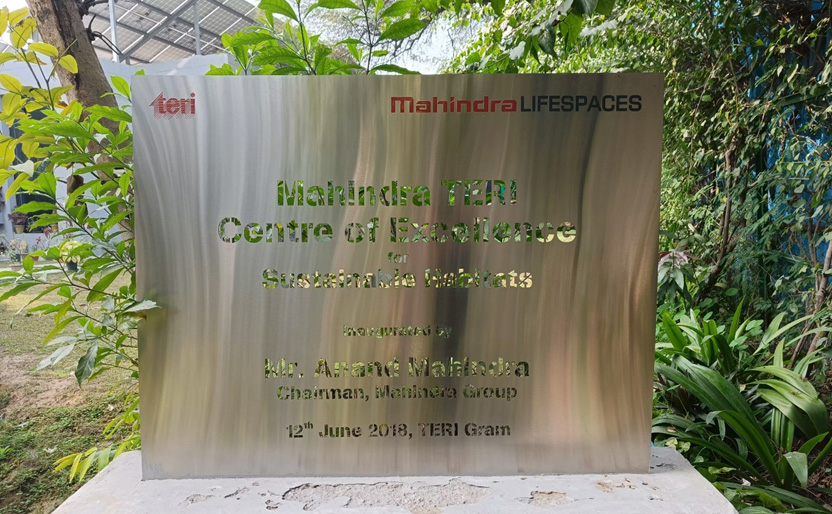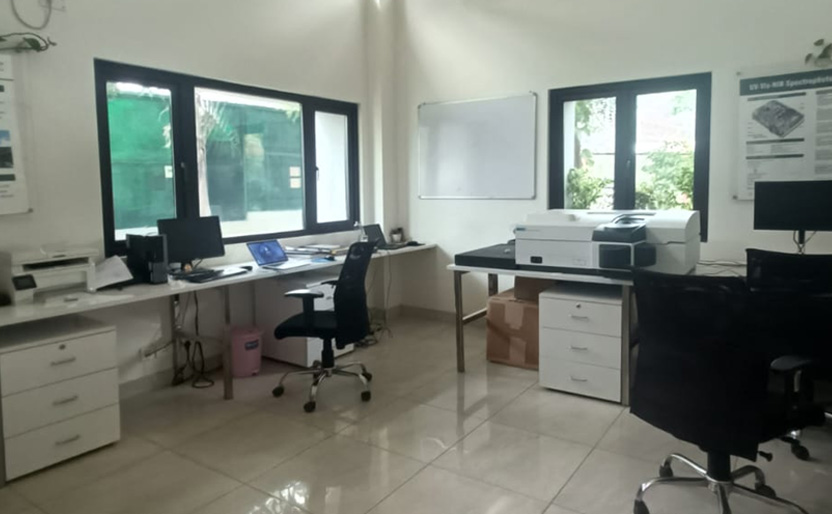
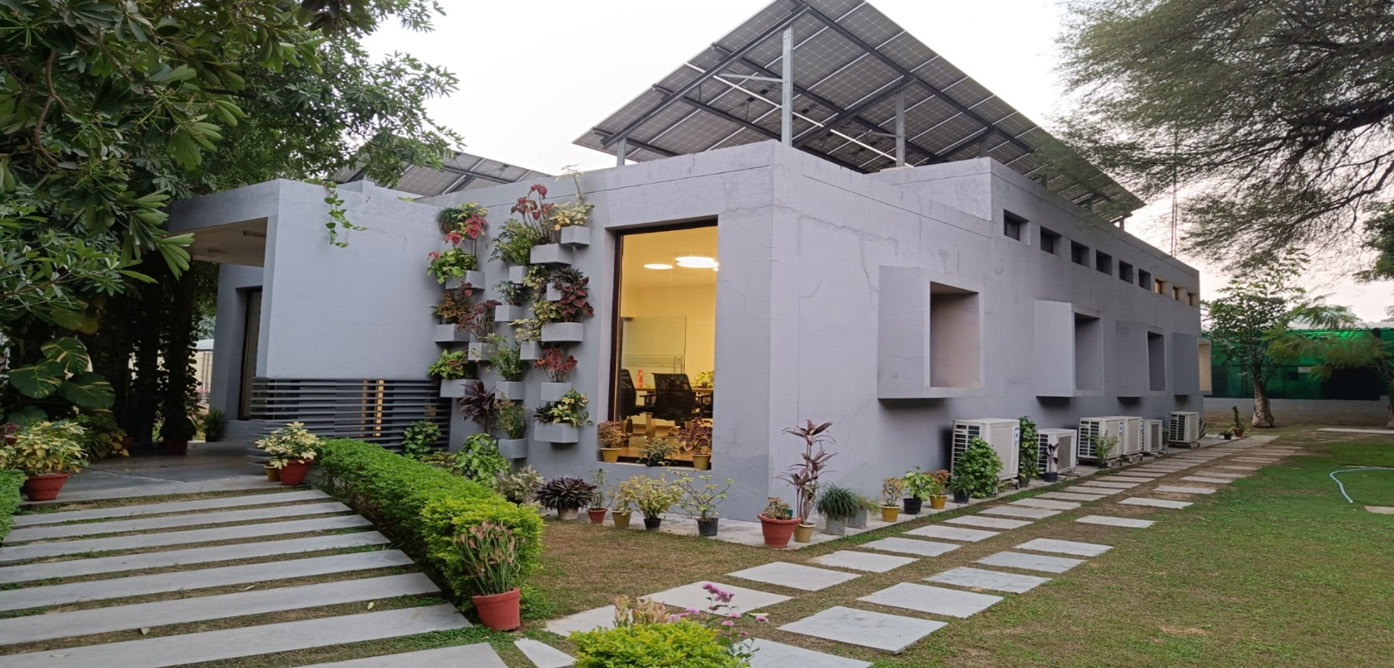
The Mahindra TERI Centre of Excellence (MTCoE) for Sustainable Habitat is a joint research initiative of Mahindra Lifespaces and TERI. Primarily, it emphasizes developing science-based solutions for India’s future-built environment, intending to reduce the energy footprint of the real estate industry. Over the past few years, the CoE has been successful in providing energy-efficient innovative solutions tailored to the Indian building sector and climates. The MT CoE lab, a SVA-GRIHA 5-star rated facility, has received the accreditation for testing thermal properties of building materials from National Accreditation Board for Testing and Calibration Laboratories (NABL).
The use of the state-of-the-art research techniques, tools and performance measurement solutions at the Centre will help generate performance data and metrics that can help to scale up the implementation of energy-efficient building stock in India. Numerical toolkits and material database arising out from the research works shall be made available in the public domain.
Objectives & Scope of Work
Material Performance Testing
Our facility is accredited by NABL (National Accreditation Board for Testing and Calibration Laboratories), a testament to our unwavering dedication to industry best practices. We utilize ISO (International Organization for Standardization) and ASTM (American Society for Testing and Materials) standards, globally recognized benchmarks for testing methodologies, to measure various thermal properties under controlled laboratory conditions.
Parameter or Scope of testing:-
| 1. Thermal Conductivity (ISO 22007-2-22) | 7. Thermal Emittance (ASTM C-1371-15 (2022)) |
| 2. Thermal Diffusivity (ISO 22007-2-22) | 8. Solar Reflectance (ASTM E903, ISO 9050, EN 410, IS 16231 (Part-2)) |
| 3. Specific Heat Capacity (ISO 22007-2-22) | 9. Solar Reflectance Index (ASTM E1980) |
| 4. R-Value Measurement (ASTM C-1363-19) | 10. Light Transmittance (ISO 9050, EN 410, IS 16231 (Part-2)) |
| 5. U Value Measurement (ASTM C-1363-19) | 11. Solar Absorptance (ISO 9050, EN 410, IS 16231 (Part-2)) |
| 6. Thermal Conductance (ASTM C-1363-19) |
Thermal Comfort and Integrated Daylight: -
With increasing population, rising temperatures and frequently occurring heat waves, thermal comfort in the built environment is bound to drive the health and wellbeing of India. ‘Thermal Comfort for All’ in an energy efficient and climate friendly manner is vital. Designing energy efficient buildings for reduced heat load, mainstreaming adaptive comfort approach, maximizing daylight illuminations and cutting down the over-dependence on refrigerant based air conditioning are central to India’s energy security and climate change mitigation efforts.
Sky Modelling: -
The International Commission on Illumination (CIE) in France has defined a set of 15 general sky types that represent different sky conditions. These models help to assess sky luminance under various weather conditions ranging from clear to overcast. Understanding sky conditions helps to design appropriate daylighting measure for the building, i.e., anything that would allow for natural light to enter the building for the occupants’ purposes. It can also be used to design outdoor public spaces, such as plazas and community gathering places. The unavailability of measured luminance data limits the use of the CIE sky model for passive window design in many countries. The CIE Standard Sky type for any Indian location is fairly unidentified.
This study at MT CoE is first of its kind to happen in India currently. It is likely to help us predict with certainty, what kind of standard sky conditions prevail on our current location of data recording The Centre has begun analysis of the recorded data, by conversion of sky scan patterns to CIE standard sky formats.
Visual Comfort :-
Mahindra-TERI CoE has prepared this abridged version of the “Glare Management Guidelines for Artificial Lighting” have been developed through a consultative process involving academia, lighting experts and building professionals. These encompass definitions for various types of glare indices, including their impact on human health. The methodology for calculating the glare indices is also included as a part of the guidelines which will help design professionals to quantify glare in numeric terms. These guidelines will keep evolving in keeping with the advancements in technologies and practices in the urban built environment
Sustainable Use of Water in Habitats
the Centre’s exercise on sustainable water use in habitats is envisioned to look at a holistic way of managing water (water efficiency, conservation and management) within a premise for sustained availability for all its consumers. The water sustainability city-level assessment, building-level water audits, and web-based tool is likely to generate awareness among relevant stakeholders including citizens, mitigate potential risks, and ensure efficient water-management at micro and macro levels. Furthermore, the outcomes of the study will help in development of policies and designing measures towards protecting the regions ecosystems, propagation and adoption of water conservation practises, and strengthening of the water governance structure and administration.
Vision
The vision of the Mahindra-TERI Centre of Excellence (CoE) for Sustainable Habitats is to develop a robust and coherent database for market-ready, scalable, and energy-efficient materials and technologies, with a focus on sustainable habitats. The CoE aims to create a greener urban future by developing innovative and resource-efficient solutions tailored to the Indian building sector and climates, ultimately reducing the energy footprint of the real estate industry.
Contact Us:
Mr. Sanjay Seth
Senior Director
Mahindra TERI Centre of Excellence for Sustainable Habitats
TERI Gram, Gurgaon - Faridabad Road, Opposite Pathways School Gwal Pahari, Gurugram - 122-001, Haryana, India.
Email : info@mahindratericoe.com
Phone : +0124-2579320, Extn: 279